
Looking to live in good faith in the workplace
As well as presently seeking out opportunities to do the work I enjoy, I also like to invest time and effort in thinking critically and reflexively about what it is I am doing and how it is experienced in practice – something that I signally failed to do for most of the time that I spent in the workplace.
Broadly, I did as I was told or asked to, in exchange for a monthly pay cheque. Quite simply, the dull compulsion of the economic secured complicity – and my view of work until recently was purely instrumental.
When I was lucky enough back in 2016 to go across to a role at the NHS London Leadership Academy, I felt that everyone who worked there had licence to take time over their activities instead of rushing to get things done. We were also encouraged to think deeply about what the organisation was seeking to do and how we might best try and achieve its ambitions.
To use the term mobilised by Megan Reitz and John Higgins in their fascinating recent research into life in the workplace, this spaciousness allowed me the opportunity to engage my critical faculties. This, in turn, led me to develop my abiding interest in power in the workplace…and how that impacts voice and silence in that environment.
A while back, I took time to interrogate the idea of facilitation in corporate settings. I couldn’t help but come to the conclusion – in light of my experience of undertaking this sort of work over many years – that a lot of practice in this domain served to limit rich dialogue and instead encouraged merely performative exchanges.
I was also concerned that inviting someone badged as a facilitator into an organisational setting allowed managers and leaders to evade one of their essential roles, that of opening up interpersonal channels amongst people so they connect and talk together in a meaningful and practical fashion.
As an introduction to this discussion of facilitation, I made a passing reference to the way many of us working in the world of organisation development also refer to ourselves as Change Agents. For those eager to create a hierarchy in this area of practice, the term Change Manager is sometimes used. Others label themselves as a Change Champion, which intimates a high degree of engagement and advocacy.
All of which made me aware of how much of my workplace activity had been about structural and cultural change. The use of the term agent also resonated with the new book I have just finished writing, which explores the workplace through a range of existentialist concepts. One of these connects the freedom that human beings enjoy through the presence of agency, with the fact we find ourselves thrown into lives which require us to make constant choices which are not of our making.
This led me to openly and honestly engage with the terms change and agent…and with what happens when they come together in the term change agent. This is a phrase that describes an increasingly high-profile practice in contemporary corporate contexts. Crucially, I did not seek to decontextualise these concepts and approach them in an abstract fashion: instead, I located them in workplace circumstances where power, voice and silence are significant yet so very often hidden.
Similarly, my critical inquiry did not involve a distracted scrutiny of these notions. I wanted to engage with how people experience such practices in their reality. So, instead of stepping away from the day-to-day in order to reflect on these things, I chose instead to step into the day-to-day to give voice to how I felt and acted in relation to these concepts in my workplace – and how those around me were then implicated in it.
To undertake this exercise, I drafted a set of reflective questions. These invited me to speak candidly about how I related to change and agency at work – and how those surrounding me in the workplace might experience my relationship to these ideas. These are the questions I used…and I share them here as an illustration of how I approached this exercise but also to offer a starting to others who might want to engage with this topic seriously.
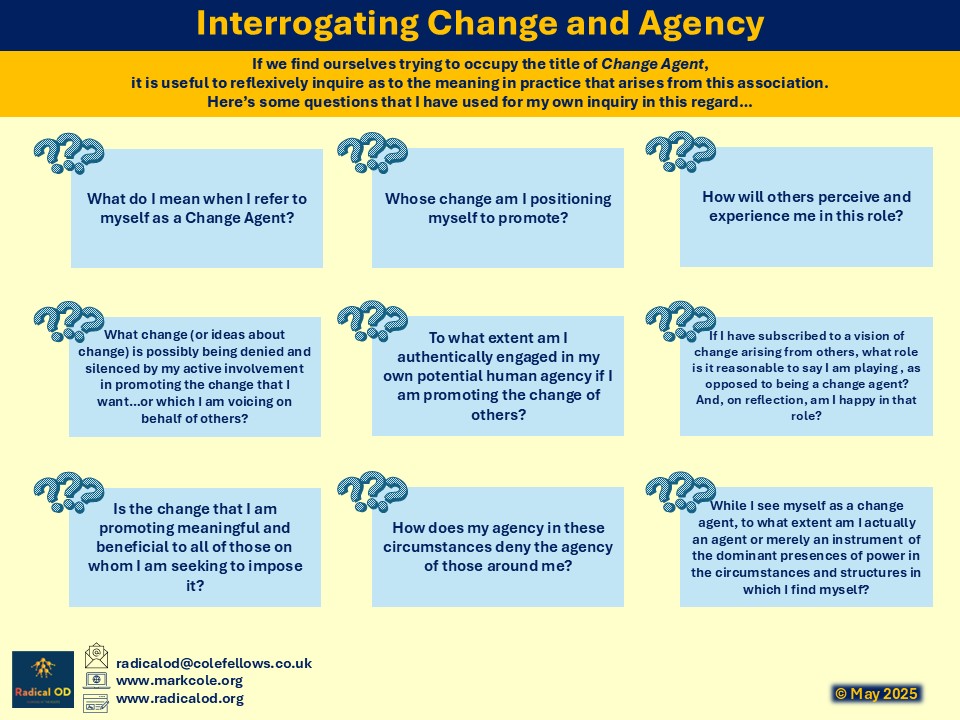
My conclusions at a high level were two-fold: first, the organisational change that I was invariably promoting was something being done to others and tended to be a transformational plan that derived from those sitting at the top of the company. Rarely, if ever, had there been an exploration of change as an intrinsic part of human existence.
One might expect there to be a constant dialogue about change in a corporate context involving everyone in the firm. This would recognise the fact that, whether someone works in the executive suite or on the reception desk at the front end of a corporation, everyone has experience of the workplace about which to speak…and will have ideas as to how that environment might be developed and improved to the benefit of those who work there and those who use its goods and services.
Secondly, I realised that I had duped myself into thinking that I was a free agent who was manifesting change in corporate settings. On reflection, I could see that I was merely an instrument of others who wanted change to occur in their context. I could not seriously think that I was exercising anything akin to meaningful agency in the role that was accorded to me and which I willingly occupied. My behaviour was wholly subordinate to others where I worked, specifically those at the top of the organisation. Instead, in existentialist terms, I was acting in bad faith by imagining that I was a human agent exercising freedom and choice and yet being in the world in an altogether contrasting way.
To engage in critical reflexivity like this is just the start: my next exercise is to find a way to act that makes my presence in the workplace authentic in the sense of exercising my agency in good faith – so changing my approach to how I work with/on/in organisational change. A starting point, an anchor for this, is to hold firmly to the need for everyone to have agency when it comes to the issue of change – and give space for the widest possible range of voices and choices.
 Radical OD