
When a manager in the health service seeks to silence a whistleblower, should we assume that this supervisor is cruel or incompetent? News that the government intends to regulate managers in the health service suggests that this is how the administration views it.
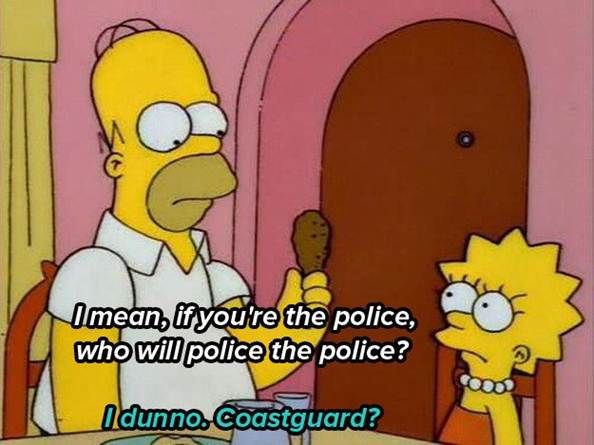
If organisational structures are robust in terms of identifying instances of poor management and leadership and also then take action in an agreed and open fashion, the introduction of a separate and externalised structure of scrutiny looks like bureaucratisation. As such, it leads us to a key and historic question, namely “Quis custodiet ipsos custodes?” Even Homer Simpson has grappled with this philosophical notion…
Alongside the question of whether there is a meaningful and effective structure to address performance in a corporate context, there is the issue of the culture in which those managers find themselves and the impact it has on how they think and behave.
A good many efforts have sought to support a climate of speaking up and speaking out across the NHS. The largest of these, of course, was the introduction of a system of freedom to speak up guardianship. Given that whistleblowing is once again on the agenda, it is apparent that these initiatives may have had peripheral effects but have left the core problem largely untouched.
Management in Context
It is overbearing corporate expectations and stifling cultural constraints that engender circumstances where speaking out is condemned and managers find themselves silencing people. It is possible to suggest that this confluence of expectations and culture generates an intense institutional defensiveness that overwhelms the ambition of managers to lead ethically. This was highlighted in Sir Robert Francis’s report (2013) into events at Mid Staffordshire NHS Foundation Trust, where it is stated that ‘It demonstrates the sad fact that, for all the fine words printed and spoken about candour, and willingness to remedy wrongs, there lurks within the system an institutional instinct which, under pressure, will prefer concealment, formulaic responses and avoidance of public criticism’ (p184).
Francis sought to also explain why managers might end up being complicit in respect to organisational defensiveness particularly in terms of responding to the sorts of so-called performance targets that are so familiar in organisational environments dominated by New Public Management, such as the NHS:
‘Self-interest may explain the actions of a management class possibly driven by the perceived likely personal and career consequences of failure to meet targets. If self-interest is a driver of a culture which does not make patients the first priority, an opposing self-interest has to be inserted. Incentives such as celebration of the raising of concerns, rewards for delivery of safe and effective care and respect for participation in innovation and a drive for excellence. Deterrents can also be effective, for example, the introduction of serious consequences for deficiencies leading to serious harm. A balanced and proportionate approach like this, implemented by visionary and exemplary leadership, should be capable of re-filling the professional vacuum.’
The idea of regulating people in the way that the government is currently promoting looks to apportion blame to an individual instead of reviewing the context in which their behaviour occurs. In typical neoliberal style, it fetishizes the sovereign individual and neglects two crucial things: firstly, the power dynamics that exist in that environment and, secondly, the systemic circumstances that prevail and impact people’s agency.
This focus is unsurprising as it can be discerned in the most recent dreary discussion of leadership in the NHS delivered not by a critical thinker but by a retired army officer, reflecting the NHS’s strange fascination with the military. This may perhaps be explained by the fact that the NHS has, since its inception, been dominated by a structure of vertiginous hierarchy and a command-and-control approach to management and leadership. The regulatory oversight now being demanded by the Labour government intimately linked to the crude educational commodification that is outlined in the Messenger report.
Part of the reason managers in the NHS feel condemned to be institutionally defensive and struggle to be meaningfully supportive of the staff working around them is the controlling environment in which they find themselves. Scope for managerial and leadership discretion is significantly limited by the infrastructure and superstructure of control that exists across the service. Which is why it feels especially ironic to propose more regulation to sit atop the present regulation that dominates and constrains managerial life in the health service.
The idea of imposing further controls on NHS managers whilst leaving the restrictive context in which they practice unacknowledged and completely untouched first formally arose towards the end of last year. A government press release from November 2024 highlighted three headlines in respect to the announcement, which were as follows:
Secretary of State pledges to hold NHS managers accountable, and ban those who commit serious misconduct.
Regulation will bring in professional standards and support a culture of transparency.
Proposals will ensure patient safety is at the heart of leadership in an NHS fit for the future.
From an organisational perspective, if an employee is not contractually accountable, one has to wonder whether the environment in which they are working is actually fit for purpose in terms of supporting both staff and its clientele. There should be an active examination of the beliefs, expectations and “the way things are done around here” that prevail in this place, rather than the construction and introduction of yet another of level of supposed oversight.
From “Training” and Rote Learning to Authentic Development
Certainly, I would deem it to be essential to create circumstances wherein managers and leaders are actively encouraged and supported to: engage with their role and the place wherein they perform it with a high degree of criticality; explore their experience of seeking to manage and lead in this context in a reflexive fashion, in order to adjust their presence and practice both as an individual and as part of a range of collectives; and ensure that they are actively engaging in the development of their ethical self, in terms of what they do and the environment that they create around themselves in which others experience their corporate lives.
A manager or leader is first and foremost a human being – so, instead of fixating on abstract curricula and formal courses in regard to leadership development, the priority should be about generating a corporate climate wherein people enjoy space and time to develop as a person. This would mean that – when the need to lead emerges – they will be well equipped from the perspective of their humanity and agency to step into the role.
In the previously cited 2024 government press release from November last year, the erstwhile head of the service – the Chief Executive of NHS England (NHSE) – was quoted as saying the following:
It is right that NHS managers have the same level of accountability as other NHS professionals, but it is critical that it comes alongside the necessary support and development to enable all managers to meet the high quality standards that we expect. We welcome this consultation and already have a range of work underway to boost support for managers in the NHS and to help set them up to succeed – this includes creating a single code of practice, anew induction process and a new set of professional standards, which will ultimately help drive improvements in productivity and patient care.
Here, we hear the voice of a regulator celebrating the development of even more regulation. For people in a large number of NHS provider organisations, NHS England was often experienced as an overbearing overseer. So supporting even more scrutiny – as opposed to stepping forward and taking the lead to interrogate the practice of management and leadership across the service and find ways in which to challenge structures, practices and the culture – seems beyond ironic. And the recent news of management and HR failure across NHSE – with a significant uplift in people lodging issues with Freedom to Speak Up Guardians in the organisation – sends us back to Lisa and Homer Simpson’s discussion of who polices the police…and prompts me to recall the old saw “Physician, Heal Thyself!”
Protecting Socialised Medicine
All of which leads me to a set of principles which need to be explored and discussed in situ. These ideas do not offer a blueprint. Instead, they invite people working in health and social care into space and time in which they can openly challenge the current mode of management thinking in and around the service – and also then to articulate their experiences and to give voice to their ideas as to how things might work better.
A similar conversational zone needs to be opened up for as many people from the populations which the NHS is there to serve as possible who wish to engage in a meaningful dialogue about their experiences and expectations. Ultimately, the conversations among staff need to centre on the expressed requirements of those communities…although it should be acknowledged that the exchange between those who work in the service and those who have expectations of it (and we should bear in mind that in virtually all instances these people are one and the same) needs also to be experienced as a dialogue. What people want and what might reasonably be possible will occasionally clash – but ensuring that any so-called consultation is undertaken conversationally means that candour and honesty need to be at the heart of such discussions.
These principles are offered here not because they are definitive but because they offer a starting point. Indeed, assuming the internal dialogue within the two groups, one of which consists of the staff and the other involving the users of the service, is supplemented by creative discussion between the two parts, this should enable all of those involved to bring their own principles to the debate and introduce them so that they are properly heard by all of their interlocutors. This is not a so-called “listening exercise”, captured in a dull and inflexible project plan and stretched unthinkingly between a start and an end, and cluttered along the way with notional milestones. Instead, this is an active embrace of the idea of genuine engagement as a permanent feature of what it means to run and be a recipient of a health service.
So, here are some statements of principle that might be used to kickstart the essential conversation – particularly in regard to those who seek to manage and lead our services – that will be a central feature of looking to deliver a health and care service:
- Where is our focus in the current circumstances in and around health and social care in terms of our practice as managers and leaders in this context? When I think about being a manager or leader, what do I envisage as my list of organisational priorities…and do I honestly consider these to be essential to actually running services? If not, what would my priorities be, if I had the opportunity to focus differently on my role and the demands that surround it?
- Setting aside the corporate values that are artificially generated and inflicted on the organisation in which I work, what are the values that I hold that steer me to do the work that I do as a manager and leader and that compel me to do the best work I can possibly do in this role? How difficult is it for me to adhere to my values in the organisational circumstances in which I work…and what would need to happen in my corporate environment to allow me to pursue those values properly?
- When I reside in the midst of my work and the place where I do it, to what extent does it feel as though the corporate expectations and strictures support or inhibit me from doing my work so as to offer a service that is genuinely attuned to the needs of the populations that we are here to serve? What would need to change to release me to engage in my work in a more authentic and engaged way, mindful of the expectations of our service users and the constraints that exist for any public service?
The more that people find the space and time in which to not so much speak up or speak out…but, instead, to speak to one another, the more topics will emerge that encourage the conversation to become richer, wider and deeper. No limits should be placed on this, in terms of the themes on which people are invited to touch.
I suspect some readers – if they have stuck with this piece thus far, in which case I offer my heartfelt thanks for your attention – may be feeling perplexed at how drastically we would need to alter how things get done in and around the NHS in order to pursue this idea of putting genuine dialogue at the heart of what we do. Certainly, the ideological constructs that exist and define what it means to be a manager and a leader in general and in health in particular would have to be abandoned…and people in role these days have an understandable vested interest in holding onto those profiles in order to safeguard their position in a corporate context.
For example, we are literally requesting that people in and just below the C-Suite abandon the idea that they qualify for their healthy salaries and are occupationally defined by being directive – and instead we are inviting them to embrace the pivotal role of being connective. We should stop imagining that one person will have the answer…and instead seek out people who constellate those around them to facilitate an exchange wherein a range of fresh ideas can emerge in light of people’s actual experience up, down and across the organisation.
Yes, then; this is a decidedly radical idea as to how we might tackle the challenges and achieve the ambitions in respect to the ongoing provision of a cost-effective and high quality socialised system of health and social care. But the alternative – doubling down on regulation whilst leaving structures and culture ignored and hence untouched – is merely to do what has always been done…without any history of positive achievement arising out of that history. We can keep on keeping on…and generate the same old outcomes. Or we can take change seriously, instead of fetishizing it as unachievable plans for transformation hatched by someone at the top of the pyramid and harshly foist upon everyone below, and go to the very heart of the matter, even if that means we have to question that heart, what it is, and what it presently does.
 Radical OD