
Existentialism as a philosophy of management
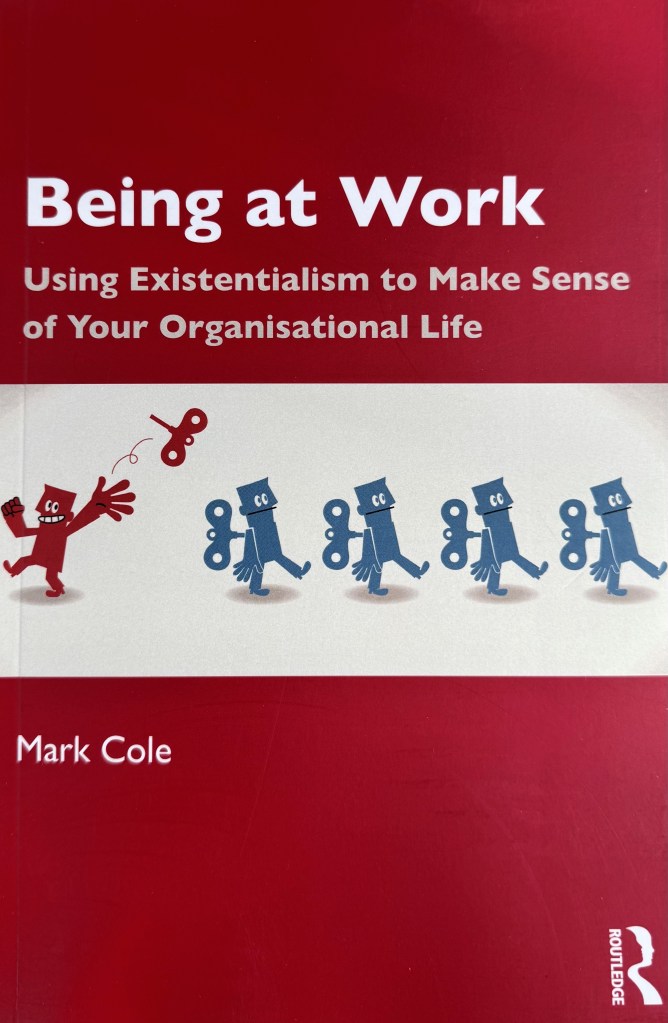
Personal reflections with an encounter with Dr Mark Cole’s upcoming book: ‘Being at Work’ (Routledge, 2026)
John Higgins, September 2025
We need to take freedom and choice seriously, not as isolated individuals ploughing our own furrow, but as people thrown into the world as it is, compelled to make sense of its facts, where the greatest act of choice each of us makes is to come together in the pursuit of collective activity. Freedom and choice as a never ending, never completed, individual and social activity, until that is we come to our end. This is the existentialist way.
‘Those who manage… our organisations… have a responsibility to make choices about the workplace that support people there to engage with their own freedom and to have space to make choices.’ (P.50)
Taking an existentialist stance is at odds with everything that currently sits within the practice of management, with its demand that people perform a role, comply to externally imposed expectations and rules – and deny their time bound, agentic, experience of being. Based on a belief in the necessity of sacrificing most of the self-life to work, organisational experience becomes life denying and so meaningless – or rather, a simulacrum of meaning.
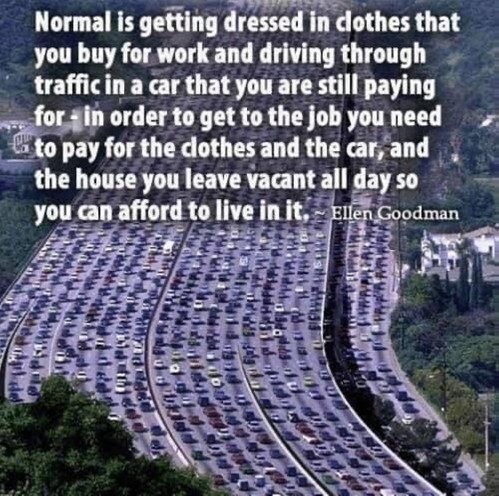
Better to be busy, to surrender to the thinking of others, than take responsibility for choosing your life. Don’t think too much is the motto of modern management; focus on getting on with what matters to more powerful others. If you stop to think, then you face into the enormity of self-authoring and owning responsibility for your actions. Authenticity is hard, relentlessly demanding of ourselves and of those around us.
If, as Mark advocates and has struggled to put into practice in his own life, we embrace the finite nature of life, and the way we are thrown into a world we didn’t choose, meaning is something we all have to make for ourselves, without surrendering to some pre-configured model or set of labels. Meaning comes from how we choose to engage with our unchosen circumstances – and it is an activity that we step into throughout our lives, as we are continuously thrown into each unknown, even unknowable, now.
As someone who identifies with, or has been given, or has chosen, the label of manager or leader, your responsibility is not to make meaning on behalf of others, but to create conditions where people own the responsibility they have for their own lives. You are not there to disappear, or lighten, the weight of responsibility each of us has for making meaning in our lives. As a manager/leader you are demanding, of yourself and others, liveliness – a willingness to be alive in the moment, to be an activist in challenging creeds which suffocate individual choice and freedom.
This is a through the looking-glass moment for management orthodoxy, where meaning is imposed on people, and the expectation is that they will become complicit in surrendering their lives to an externally mandated, inauthentic expression of self.

Mark’s purpose in advocating, and living, this style of philosophy is:
‘I want to consider how existentialism might serve to humanise the workplace… where a good many of us spend a significant amount of [our limited] time.’ (P. 21)
This builds on his understanding of what it means to be an authentic, rather than inauthentic, human being – an inauthentic person being one who allows themselves to be entirely defined by others, who surrender their way of being in the world to a pre-given set of framings, so every moment is only known through the framing used, and not for the uniqueness of the now. The label is seen as existing before the experience, rather than vice-versa. To repurpose a well-used phrase, the inauthentic life privileges the map before the territory of experience. The consequence of the map led life is that a person allows themselves to be defined by others:
‘If we concede that freedom and choice are significant aspects of being human… then the absurdity of life should be a fleeting thought, subsumed by the agency we have to weave meaning and purpose into our existence.’ (P. 59)
What then is the first step for so-called manager or leader to take, where they are keen to be in the service of a life-affirming practice, rather than one which seeks to deny people the responsibility for the most important work they can do with their lives i.e. to exercise choice and freedom and find their own meaning in the company of others:
‘Instead of aspiring to be a ‘good manager’ or a ‘respected leader’ we should focus on being a thoughtful human being, looking to find our way through the complexity of life – and mindful of the way in which our presence in the world impacts others.’ (P.96)
This is a world away from the managed niceties of terms like empowerment, where agency remains as a gift of the empowering other. This manager/leader as ‘thoughtful human being’ is someone who invites deep-seated, self-chosen, agency in themself and others – where agency is understood as the fundamental wellspring through which a free person acts into the world. The authentic and agentic are deeply intertwined terms.
In established management practice, the focus is on setting boundaries to people’s sense of agency, and by doing this looks to condemn them to a non-life of surrendering responsibility for choices and decisions that should only be theirs to make:
‘Existentialism… rests on the key notion of acknowledging agency… It is about a life… lived through activism as opposed to complicity.’ (P.130)
Alongside this neutering of a sense of personal agency, current organisational orthodoxy looks to disappear the richness and complexity of life by demanding compliance with a way of knowing that serves a life denying ideology:
‘In our corporate settings [a] focus on quantifiable measurability… serves to silence people [by] denying them the chance… to share the richness of their insights… they derive from experiencing their world.’ (P.137/8)
It is no surprise then that most corporate speak-up initiatives achieve so little. They do not come from a place of good intent, where good intent starts with inviting people to choose how they wish to talk about, express their experience of experience. When you must speak using the tongues of others, your voice is inauthentic, your authentic experience is disappeared by how others have decided your experience can be made public.
To embrace an existentialist approach to management places a weighty burden of responsibility on everybody, whatever organisational label or hierarchical position they hold. It lays at your door the fact of your responsibility for the choices you are making every moment of every day, where even choosing not to choose is of course an existentialist act.
‘Being responsible for creating myself from nothing, as existentialism suggests, is a massive responsibility. Being me rests exclusively on my shoulders… and I can’t blame anyone else for the me that I might be.’ (P.154)
Once that responsibility is acknowledged, then a clear-cut philosophy of management emerges, which applies to all – whatever role they are being invited to occupy:
‘We need to take ownership of our freedom – and create space around us, for others to possess their own freedom.’ (P.157)
At the heart of the existential management discipline is its aliveness, it’s never-finishedness (until we all reach our own end), it is the task that can never be completed and ticked-off. Our need to individually and collectively exercise choice and freedom never ends, because the circumstances that we are continuously falling into are always in flux. It is a way of life, not a role to be performed.
What this aliveness gives any organisation is a community of deeply responsible people who are in constant touch with the unfolding world around them – and so making more likely that any course of individual and collective action is in tune with the world as it is (and not as people who inhabit a dead script would have it be).
‘As managers or leaders… we should avoid trying to constrain the open system through which those around us will be looking to develop.’ (P.173)
* * *
This essay is a personal reflection, inspired by a close reading of Mark’s book ‘Being at Work’. It is a sense I’ve made of it but will never be the sense – as I go on chewing it over. Its intention is to invite curiosity in others so they too might engage with Mark’s book and go on to make their own sense.
John Higgins, September 17th, 2025
 Radical OD