
Being a dweeb d’un certain âge, I get pleasure from doing crosswords in my daily papers. (If anyone finds themselves confused by any of these terms, don’t hesitate to contact me and I’ll fill the gaps!)
Recently, I finished writing a book that explores our working lives through a range of existentialist concepts. In doing so, I looked to weave together philosophical thought with the actual experience of my life. This led me to think deeply about what it is to be present in the present, as opposed to lost in the past or fixated on the future.
Making Space
At the same time, I have been hugely fascinated by the work that Megan Reitz and John Higgins have been undertaking recently that identifies how focused we all tend to be on what they call “doing mode” …which means in turn that we find ourselves denied spaciousness in which to reflect and think.
Interestingly, a practical appreciation of this arose for me as I was doing crosswords, which I tend to complete online and which as a result are timed. I would often get snagged on an obscure clue to which I simply felt I could not offer any kind of solution. Unable to complete the entire grid and with the timer endlessly ticking upwards – a constant reminder of time passing – I would merely interpret this as a crucial gap in my knowledge and abandon the puzzle.
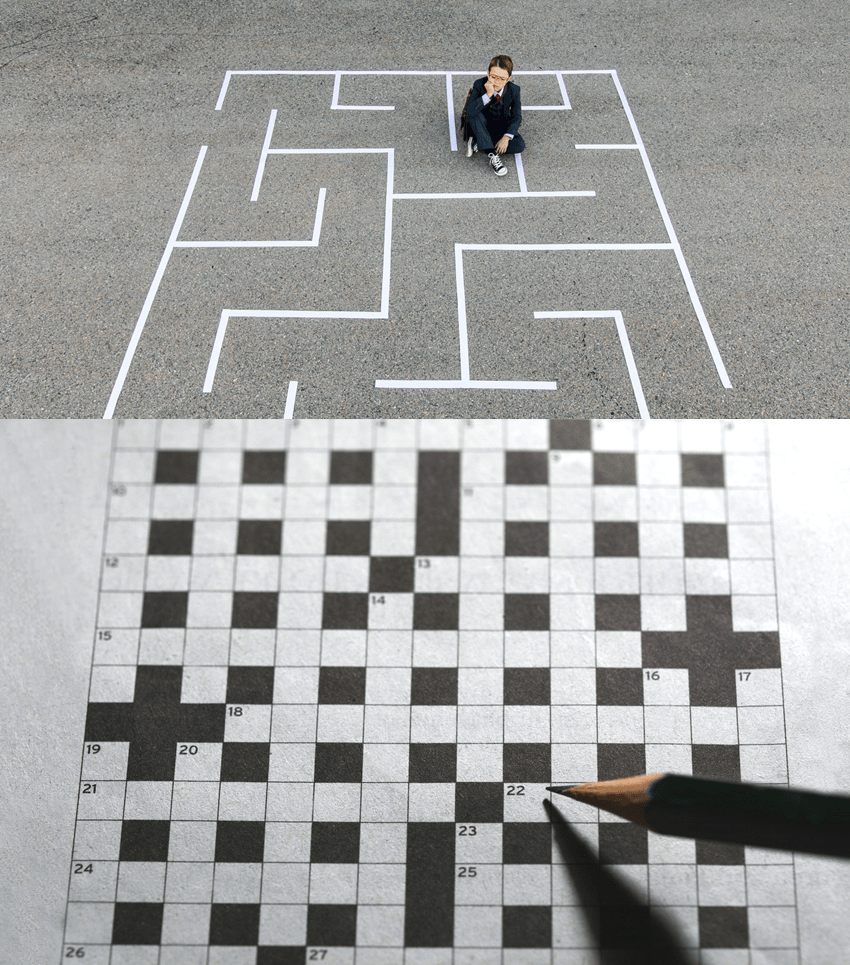
Thinking about spaciousness, however, I found myself returning to the crossword regardless of how much time the newspaper app had logged and that it was continuing to mark the passage of time. And what was interesting was that sometimes – in fact very often – going back to the puzzle meant that I saw it very differently and suddenly accessed the answer to the clue on which I was previously stuck.
I went from thinking, “I’ve no idea as to the answer to this, it’s a massive gap in my knowledge” to suddenly realising that a moment’s pause and a step away from where I had found myself meant that I was engaging afresh with my life and all of its various elements. Very often, looking afresh at the clue, I could suddenly see the answer, the very same answer that a mere while back I had assumed was something I simply did not know.
A moment’s pause and a step away from the specific circumstances served to reveal that I did know the answer…and that I simply needed to allow myself space and time for it to emerge. I needed to take the pressure off myself in terms of the internal demand that surely I must know this and then the assumption that I didn’t. And, in terms of another pressure, I needed to disregard the ticking timer.
I needed to stop dancing to oppressive tunes that were externally and internally composed and then imposed. Instead, I needed to slow things down, in order to grant myself space and time in which to consider the topic, step away from it, and then return to it, without being fixated on delivering the right result in the minimum amount of time.
Space and Agency – at work
This experience has made me go on to think about the workplace as a crucial location wherein we live a life structured by a constant and distracting set of junctions between deadline and output. Which leads to a philosophical question: what would management/leadership practice look like in contemporary corporate contexts if it was not nigh on exclusively fixated on getting stuff done quickly? Could there be a practice that allowed the workforce to explore their autonomy by making the workplace a space in which people can live a creative working life in the absence of pressure and restraint?
Of course there could… But it would require a big step away from familiar notions of power and hierarchy in organisations; a surrender of status, because so much of contemporary management is defined by the exercise of control; and a willingness to allow people around you the freedom to live their working lives as human beings rather than human resources.
 Radical OD