
In the course of the Accuracy of Silence catch-up call that I hosted for an hour on 20 November 2025, I was – as ever –totally absorbed by the rich and insightful conversation that this small group enjoyed.
As ever with this kind of discussion, we began with no agenda and allowed our exchanges to take us wherever they led. As I’ve suggested previously, the artist Paul Klee spoke of drawing as “taking a line for a walk”, while sessions such as this one very often see their participants sharing experiences and taking ideas for a walk.
My reflections thereafter have led me – in terms of my personal engagement in the dialogue and my subsequent reflections on what I heard – to capture the following highlights (and reflexive prompts) to consider.
Living a Corporate Life
Very often we are affected by a tendency to be compliant with the dominant discourse in a corporate setting, in light of the power it has to define the environment in which we find ourselves and how we should be therein.
We also find ourselves occupying paradoxical positions in corporate life, such as residing in the gap between organisational values – an anodyne list of apparent expectations in terms of presence and practice – and what is actually valued in that setting, namely delivering outputs at pace and a model of how we should turn up as corporate entities.

Kinds of Kindness
A fascinating insight arose from this observation about the contrast between values and what is actually valued in respect of the experience of kindness in the workplace. It is possible to envisage a circumstance in which those at a senior level in an organisation feel obligated to be kind to a middle manager of 10 performers, even though that manager demonstrates no kindness whatsoever towards their direct reports.
Hence, there is a need to steer away from an absolutist definition of what kindness means and instead to be alert to what is happening in terms of the dynamics between people in your organisation and how people are experiencing that, particularly in respect to their hierarchical interconnections.
It was also pointed out that there is a kindness multiplier effect to be aware of in this context. A person being unkind to a group of 10 staff is potentially creating circumstances wherein those 10 people carry unkindness into the context of their home lives.
Writing our own Tune to Dance to…
Some of our complicity in such regimes derives from the sense that as human beings we spend a significant amount of time trying to please and – linked to that – seeking to guarantee our sense of belonging.
The tune to which we find ourselves dancing in business settings tends to be one wherein a focus on performance is privileged over a high level of essential engagement with the space and time in which we find ourselves. This can perhaps be best summarised as the fact that there is a tendency in the workplace for us to be defined (and define ourselves) as human resources as opposed to human agents.
For example, it is helpful to take some time out to think about how we imagine ourselves in our working lives. We may shroud ourselves in a corporate term such as “provider”, which rigidly yet subtly defines what it is that we are expected to do and – to an extent – how we should turn up do it.
In a later conversation with another interlocutor, they raised the fact that many business terms of this sort – such as “streamlining” – disguise the reality of the practice behind such terms and create a protected vocabulary into which those ambitious to progress managerially must immerse themselves and be seen to deploy in the workplace.
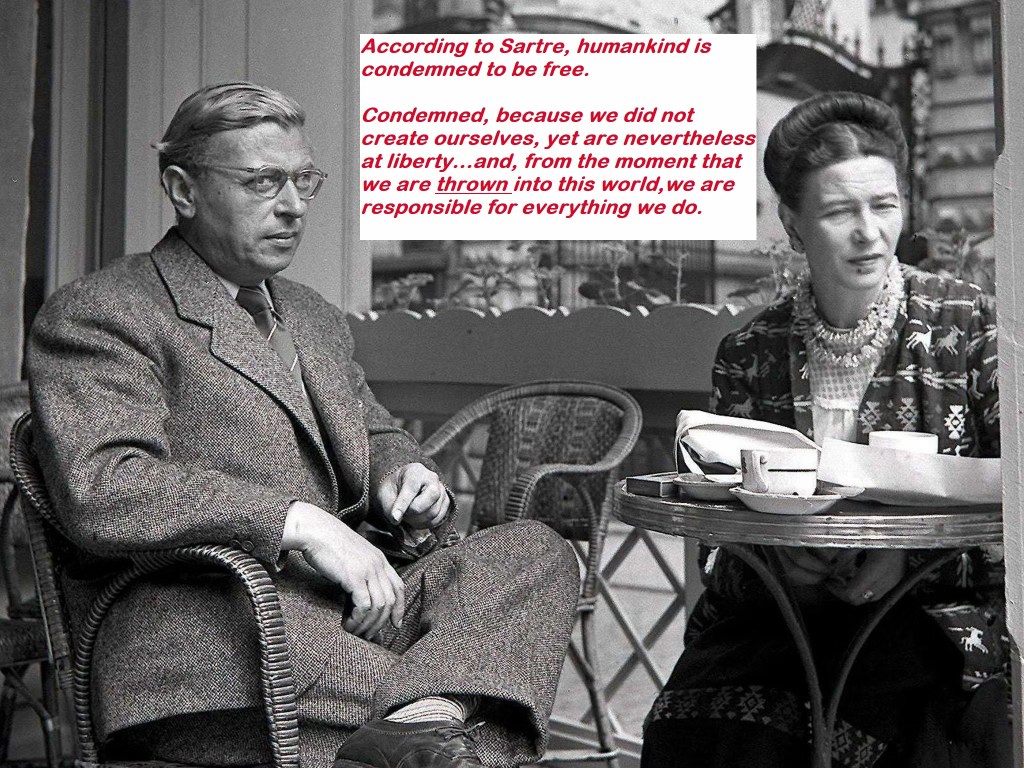
As I argue in Being at Work: Using Existentialism to Make Sense of your Organisational Life, a crucial step towards living our working life in good faith is to eschew the fixed categories to which people are expected to aspire in the workplace and instead to recognise that we are defined as a human being by the freedom that ultimately we possess to make choices about how to live the limited amount of time we have to spend on this pale blue dot hanging in the void.
This is what Jean-Paul Sartre meant when he argued that existence precedes essence: how we choose to live our lives defines us, while efforts to force ourselves to fit into one of many models of being that exist in social settings are a denial of that vital agency. It’s a tough ask…but a crucial one!
 Radical OD