
In the work that John Higgins and I have done on corporate leadership, we have taken time to highlight how developing people in respect to this practice should not be about crafting a curriculum and designing a system for its delivery.
Regrettably, there is a sizeable industry and an oppressive global spend on such activity, even though few clients paying for such interventions take the time to assess whether it has been insightful and applicable. In 2015, it was estimated that $356 billion had been spent on this activity around the world but little evidence can be found to show that this has been in any way beneficial.
In place of the panoply of programmes, we suggest that ultimately it is about creating an organisational environment wherein everyone can find space and time to think about and engage in their development not as something called a “leader” but rather as a human being. In particular, we focus on creating circumstances where you and those around you are able to actively engage in criticality, reflexivity, and the enhancement of your ethical self [pp218-219].
Instead of indulging the fiction that it is possible to train someone to become a leader, we are taking a position that a person who feels comfortable with the following is well positioned to step into leadership as and when the opportunity opens up and in circumstances where that person’s particular leadership is best suited:
- Looking at everything around them in a critical fashion, including all of the things that feel to them to be common sense or that have ended up as part of an unchallenged routine.
- Recognising that reflection is not about stepping away from the world and scrutinising it from an abstracted distance but is a practice that needs to actively recognise that each and every one of us are an intrinsic part of the world and directly affect it in respect to that presence.
- Thinking in depth about what ethical behaviour means to them in the contexts in which they find themselves working – and being and doing in the world in a way that reflects their commitment to a personal ethics rather than allowing corporate culture or the desire to belong to shape how they choose to live their lives.
A Matter of Morals
The latter is crucial, as the corporate context in market or state capitalist societies puts profit and dividends at the core of leadership practice as opposed to doing the right thing. Major scandals that demonstrate a profound lack of ethics include Enron and also Lehman Brothers, the latter seen to have precipitated a global fiscal crisis that adversely affected the entire economy. We have also seen VW falsifying test results in respect to car emissions and Theranos making false claims for medical product efficiency – and there is also the seemingly ongoing crisis at Boeing, particularly in respect to the 737-MAX.
Corporate leadership too often merely follows the dominant business line instead of encouraging people to follow their brain and heart, with those two organs working in close collaboration. While you can induct people into the theory of personal ethics – in terms of offering some teaching around philosophy and perhaps throwing some case learning into the mix – you cannot train them to be ethical, which ultimately is an active choice of a human agent.
Similarly, it seems unlikely that any supposedly educational intervention designed to encourage people to question the systems, structures and hierarchies in which they find themselves could actually be supported by the innately conservative construct that forms the basis of most workplaces. There might be a theoretical acknowledgement of the need to challenge the context in which one finds oneself…but the power dynamics of this situation are unlikely to allow people to actively challenge why things are done and how they are done in that specific organisational location.
In the same way as leaders in companies ceaselessly suggest that people should feel free to speak up therein yet refuse to meaningfully listen on those occasions where people do find their voices, so the training around leadership might seemingly encourage people to challenge the dominant thinking and practice that surrounds and constrains them – but is unlikely to actually license them to step out of their role in order to take a potentially drastically disruptive critical perspective.
What’s Right?
I was prompted to return to these considerations in regard to the question of ethics by a conversation that took place in my existential psychotherapy session last week. I found myself recounting an anecdote from the time when in my early 20s I was an Operating Department Orderly (ODO) and – in light of my Labour Party activism at this time – I had been elected as one of two NUPE shop stewards at the hospital where I worked.
A short while after the publication of the Griffiths Report in 1983, which presented a political case for the administration of our National Health Service to actively embrace private sector management outlook and practice, up to and including the recruitment into the NHS of actual managers from private companies, I found myself no longer in negotiation with people dedicated to the service and committed to its effective well-being. Instead, I was sitting across the desk from a General Manager poached from a UK supermarket and a Personnel Manager who had previously been employed by British Airways.
I was one of six porters in the operating theatres there: as I have discussed elsewhere, between 8am and 5pm the work was largely just about brawn; out of hours, however, the theatre porter transformed into a valued member of the medical and nursing team. The overnight on-call sessions and working the occasional rostered weekend were paid as overtime…but the pay rate did not of course reflect the shift from basic physical labour to actively supporting the nurses and surgeons in their clinical work.
On one occasion, a situation occurred where the on-call porter could not take up that responsibility. Procedurally – notwithstanding the informal shift in status that occurred for an ODO and the expansion of their role into more directly clinical activity – such an absence simply meant that the portering duties were undertaken by the general portering staff. This night, however, the managers decided to demand that one of the porters would have to stay, regardless of the plans they had.
Rather than the General Manager of the hospital or the Personnel Officer pitching up in our changing room to insist on this, they dispatched some poor young soul who was employed as a management trainee. At one point, this character was blocking the doorway and preventing one of the porters from leaving, even though this person had expressly and politely stated that they were not available. This antagonised my colleague, who suddenly muscled up to the trainee and said that, if he did not move, he would punch him through the wall. I vividly recall seeing the manager’s knees trembling in the legs of his grey suit, just before he stepped aside and started to pressure another of my workmates, who told him to “f*** off” as he walked past him.
At this point, the management representative who had been put in harm’s way absented himself at great pace and the rest of us gathered our things and made our way downstairs to clock off. The following morning, however, there were no clocking-in cards for us, and we were all told by the Head Porter that we were expected in the General Manager’s office. On entering that space, I made absolutely clear that I was present to represent the staff as their elected steward. Nevertheless, the man who had a month or so ago been busy selling beans and such like contradicted my position and stated that I was a witness to what had happened so was expected to respond to a series of questions.
First among these, of course, was the essential query as to what I had seen in terms of my two workmates threatening and abusing the management trainee. Without hesitation, I made eye contact with my interlocutor and stated that none of what the trainee alleged had actually happened – and that I was unclear as to why he was lying like this. I can still vividly recall the spasm of disappointment and anger that ran across the General Manager’s face in reaction to my decision to deny that what had occurred had ever actually happened.
This seemingly created an impasse, although my colleagues were penalised and I became a management target…and that managerial pursuit over the coming couple of months saw me leave to go to college as I had planned to do with a final written warning on my file for having at one point denied the authority of the nursing sister who oversaw the theatres.
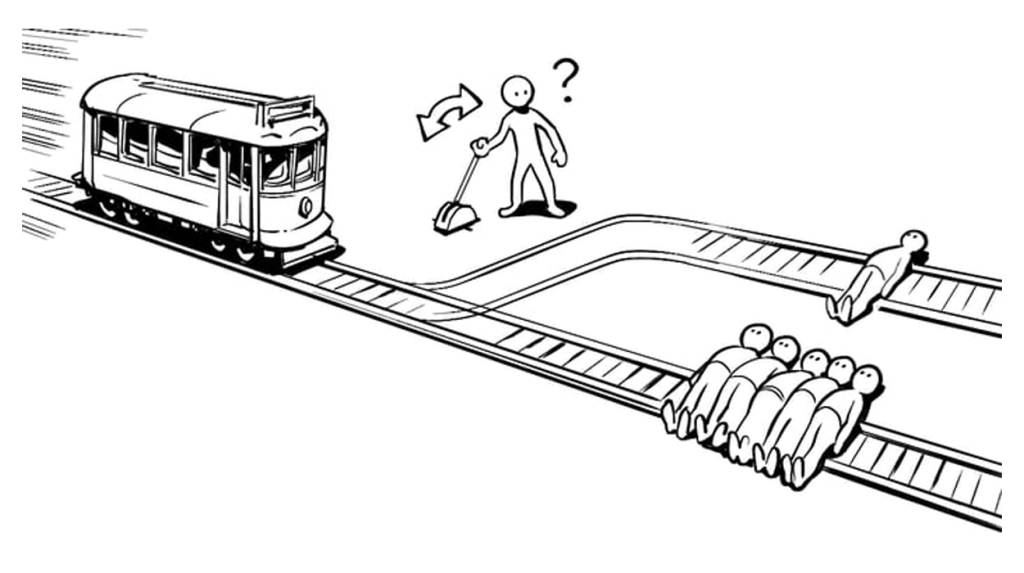
All Right?
This was one of my formative experiences in terms of leading me to recognise where power resides and how it asserts itself in workplace situations. At the time when I denied that the events had taken place, I was adamant that what I was doing was the right thing. I was expected to represent the workforce in the face of unreasonable management demands and behaviour, so – insofar as I felt that the management had been abusing their power in terms of insisting very late in the working day that one of the theatre porters should have to cover the on-call – I felt it right that I should lie to protect my workmates, as I had no other weapon available to me.
In my conversation with my existential psychotherapist last week, however, I found myself subscribing to a completely different view of what might be thought to be right. My view now is that it would have been right to describe what had occurred – and to embellish that narrative with observations about how both sides had perhaps behaved in a way that was innately conflictual rather than conciliatory and collaborative.
The managers could have asked if anyone was available to cover the night – but then quickly withdrawn in favour of an alternative solution when it was apparent that no one was free so to do. And it would have made sense for all of those senior staff in the hospital to have attended in order to support a conversation rather than sending the most junior person all on their own.
Meanwhile, the workers should have calmly stated that they were unable to do the on-call…and should not have resorted to a threat of violence or statements of abuse that effectively bullied a person merely seeking to try to do the job that those above had dumped on him.
In Sartrean existentialism, the statement that existence precedes essence is a central principle. It means that we are defined by the freedom we exercise and the choices that we make moment by moment in our lives, rather than by a perceived and socially accepted model of being a human to which either we aspire or into which we feel ourselves forced. Back in the early 1980s, I was allowing myself to be shaped by a crude picture of a left-wing activist and trade union representative. By the same token, those on the other side of the desk were presenting themselves as what a powerful manager might look like.
In that manager’s office back in the day, we each assumed our roles in relation to one another – and, as a result, we each of us in that moment unthinkingly accepted that what we were doing and how we were choosing to do it was right. Now, in light of the passage of time, a range of experiences, and a shift of opinions, I take a different view, specifically that it would be right now to tell the truth and navigate within the parameters of honesty.
Importantly, both positions are right – and that rightness can co-exist. It is not merely that time passing can change our opinion and definition of what is right. Instead, I was right then, and I am right now, in terms of thinking about those circumstances. This serves to remind us that there is no fixity in terms of rightness; it cannot be thought of as a moral absolute.
Critically Reflexive Ethics!
Earlier in this piece, I spoke of three distinctive elements that can be used to develop us as human beings. They were seemingly separate, albeit closely interrelated. However, my thoughts about the question of rightness lead me to realise that ethics is a way of being, not simply a way of doing things. Even more importantly, it is not a closed process defined by a beginning and an end: instead, it needs to be expressly explicit in our experience of life moment to moment…and it needs to be critical, so that we find ourselves constantly interrogating the rightness of choices we make and opinions that we state.
In light of that, of course, it also needs to be implicitly reflexive, meaning that we do not step back from the circumstances that our actions have created and review them as if they are separate from us. Rather, we recognise the position that we hold in the centre of the various environments in which we find ourselves – and reflect on our ethics from that pivotal perspective.
All of which recasts the very idea of rightness in respect to ethical orientation: in a given moment, an action may be deemed to be right, but – as we interrogate that act and the thinking that undergirds in the moment that follows and in moments thereafter – we will likely find that a different action might also have been right…and potentially preferable.
In the manager’s office, my choice of how to be in that circumstance reflected two things: firstly, a belief that the situation was not immediately of the making of the theatre porters, who as a result found themselves reacting in light of the pressure that management opted to deploy and in the only way that seemed available to them amidst the disparity of power in which they found themselves; and, secondly, the fact that, instead of embracing my human agency in respect to my freedom and capacity for choice, I opted to embrace the way that the accepted image of a left-wing activity and trade union rep was deemed to behave.
All of which serves as a reminder that we all of us – especially those charged with management or leadership in corporate contexts – have a responsibility to build our practice in those roles around a meaningful, personal commitment to thinking and behaving ethically. This requires us to place our critical and reflexive ethics over and above the corporate demands that shape our working lives – and which some then end up promoting in order to constrain the lives of those who they are required to oversee.
One decision can be seen to be right, given the circumstances faced and the way that we sought to navigate them. But a contrary decision can also be seen to be right in light of us putting our ethics at the core of our being, rather than a technique to which we turn when faced with a difficult and potentially impactful corporate decision.
Rightness and Contemporary Politics
Embracing the idea of the fluidity of rightness – and our assessment of it in respect to our actual experience of living moment by moment – also for me has a strong resonance with the damaging constraints on political dialogue that are discernible at this time.
The Right asserts the rightness of their position by intimating that is it obvious that they speak on behalf of a silenced majority; meanwhile, the Left justifies its positions by relying on something akin to faith and religiosity, arguing that they are located on “the right side of history”. Neither position opens up space for dialogue and for a capacity to meaningfully review and potentially change one’s perspective.
Alongside this passing observation, it is worth considering David Hume’s concept of the sensitive knave. Hume makes the argument that,
[A]ccording to the imperfect way in which human affairs are conducted, a sensible knave, in particular incidents, may think that an act of iniquity or infidelity will make a considerable addition to his fortune, without causing any considerable breach in the social union and confederacy. That HONESTY IS THE BEST POLICY, may be a good general rule, but is liable to many exceptions; and he, it may perhaps be thought, conducts himself with most wisdom, who observes the general rule, and takes advantage of all the exceptions.
David Hume (1777) An Enquiry Concerning the Principles of Morals – Section IX
https://www.gutenberg.org/files/4320/4320-h/4320-h.htm#2H_SECT9
This view of the world seems to argue that it’s OK to break the rules for your own personal benefit providing this act is not perceived by you as adversely impacting on the generally accepted way of seeing things. This can be seen to mean that rightness is simply defined by being able to get away with things that fly in the face of the wider way in which the world is experienced. It is a brutal assertion on the capacity of the individual to live their life without a huge amount of consideration in respect to the experience of others and the wider social contract.
This stands in sharp contrast with the view expressed by Noam Chomsky, the globally recognised linguistics expert who also strongly advocates an anarchist political position. In a work that looks to contest Chomsky’s anarchism, the writer Bob Black makes the following observation:
[Chomsky] brags that he stops at red lights even at 3:00 A.M. when no pedestrians or other motorists are around. Under the circumstances, running a red light is a victimless crime. But for Chomsky, who respects the law, there can be no such thing as a victimless crime. He isn’t kidding about the red light, as shown by an anecdote recounted by one of his fans, Jay Parini. They were walking down a road and came to a crossing: ‘the light was red, but – as is so often the case in Vermont – there was no traffic. I began, blithely, to cross the intersection, but realized suddenly that Chomsky had refused to work against the light. Mildly embarrassed, I went back to wait with him at the curb until the light turned green. It struck me, later, that this was not an insignificant gesture on his part. He is a man profoundly committed to law, to order – to the notion of a world in which human freedom operates within a context of rationally agreed-upon limits.’ Surely this was another victimless crime.
Bob Black (2014) Chomsky on the Nod. https://theanarchistlibrary.org/library/bob-black-chomsky-nod.pdf. p43
Alongside my specific discussion here about engaging with rightness as something that – for human agents – is constantly evolving for us, the tension between the positions held by Hume and Chomsky offers an excellent opportunity to further interrogate the idea of rightness, particularly for those who find themselves in senior roles in respect to corporate management and leadership.
 Radical OD