
To what extent does the managerialist shift explored in the previous essay matter? At the end of the day, it’s merely a question of who has acquired the power to boss us around. One time, this would have been perceived as a Lord of the Manor; latterly, it ended up as the business owner; and now it would appear that the expansion of the cadre of managers in both our workplaces and across governmentality means that there is a new ruling class to which we are forced to show allegiance.
Historic aristocracy notionally derived its status and authority through its relationship to a member of royalty who themselves asserted their right to govern in terms of their supposed relationship to God. Business owners assumed their hallowed position in the social hierarchy through their association with capital and the vacuous fable of entrepreneurialism. And now we genuflect before people who have somewhat arbitrarily been elevated into workplace positions where their role in the organisation is deemed to include the capacity to supervise and direct the activity of people below them.
To be deemed a manager – or even more importantly in our present culture to be defined as a corporate leader – is to occupy a hallowed role in a social hierarchy that supports capitalism and its persistence as a system that is both biased, iniquitous and unthinkingly focused on growth, regardless of the negative impact of that fascination on the pale blue dot where we live.
To that extent, there is a strong sense that those of us who end up in management – particularly at senior levels in corporate life – are occupying roles that have a decidedly neo-feudalist feel to them and which accord us a status that extends beyond the walls of the workplace and sees us occupying positions akin to those previously assumed by politicians, capitalists or historic nobility.
That said, discussions around neo-feudalism – involving politicians and theorists such as Thomas Piketty and Yanis Varoufakis – tend to look at the way in which shifts in terms of the development of largely uncontrolled mega-corporations under the stewardship of tech-barons like Jeff Bezos have served to allow the fundamental nature of capitalism to persist. A key title in this regard by Joel Kotkin is seen to argue that ‘Following a remarkable epoch of greater dispersion of wealth and opportunity, we are inexorably returning towards a more feudal era marked by greater concentration of wealth and property, reduced upward mobility, demographic stagnation, and increased dogmatism.’
However, the argument I am seeking to promote here specifically is that managerialism has been used as a way of notionally humanising the grimness of traditional capitalist relations and shifting the locus of control from a class of owners to one made up of people who manage capitalism on their behalf. In the way in which, within the Trotskyist tradition, Tony Cliff and the International Socialists argued that the Soviet Union was state capitalist rather than a workers state, so it is relevant to make the observation that present day capitalism is managerially defined.
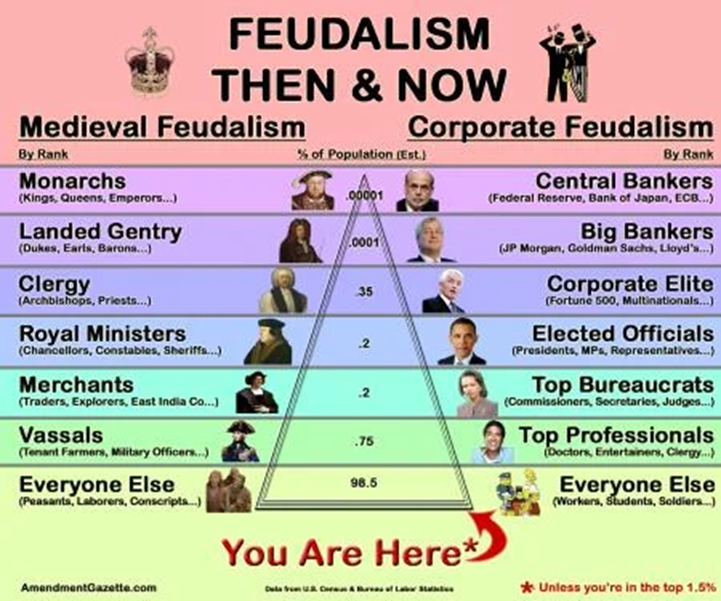
This diagram represents one interpretation of how a feudal hierarchy has emerged in late capitalism. However, this does not capture the crucial fact from my perspective that senior corporate leaders and those in upper echelon managerial roles are effectively adjuncts of the ruling class in contemporary capitalism. Whilst our economy bears many signs of a new feudalist structure, fundamentally we are seeing the arguments advanced by James Burnham back in 1941 and, more recently, by Duménil and Lévy that capitalism has protected itself and is allowed to persist by the development of managerialism.
In the third chapter of this four part essay, I will look at the contemporary tension between a limited sense of accountability at the level of senior leadership in contemporary capitalism and the charmed existence that many top level managers can be seen to enjoy. This persists, of course, whilst those further down the pyramid – such as the organisational tier of managers of performers, in contrast to managers of managers – are ceaselessly pressured in respect to a defined approach to deliverability.
 Radical OD