
Corporate life tends to accentuate the linked notions of responsibility and accountability. The former relates to a practical obligation to get something done, whether that is something that you have personally identified or an activity that has been delegated to you via a formal hierarchy. The latter however is about allowing yourself to be publicly seen as the driving force around things getting done, whether they are successfully completed or end us as a failure. Organisational life tends to clumsily allocate responsibility to everyone therein, whilst accountability tends to be seen primarily as something that applies to managerial or leadership practice.
In respect to being accountable as a person occupying a role in the upper echelons of a company, there appears to have developed a tendency for that relationship to be profoundly eroded. Where previously a boss in their top floor office might well have lived their organisational life with a strong adherence to the notion that “The Buck Stops Here”, we now see those senior personnel as mere channels for the dissemination of agreed responsibilities across the workforce. Moreover, in keeping with managerialist neo-feudalism, those people paradoxically embrace the notion of heroic leadership, the ideological idea that effectiveness is all about the individual asserting themselves, whilst failing to embrace the idea that achievement in that realm arises out of their management or leadership. Hence, we find a situation wherein the senior person embraces a narrative that focuses on the notion of the leader as opposed to the practice in that role.
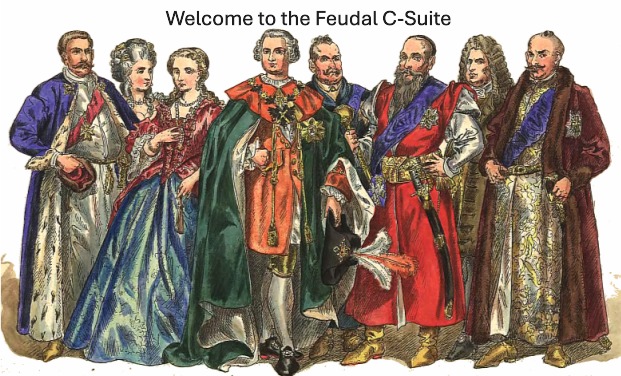
Just like a Lord of the manor or an early industrialist or indeed an historical political figure, the status of the senior manager or corporate leader is no longer defined by competence in terms of responsibility and accountability but is now attained simply by being invited by those above to progress to a position higher up in the company structure.
A Charmed Existence
This assertion felt to be extremely apparent with the arrival of the New Year Honours list. In politics, for example, we find the Labour leader of Lambeth council in south London being awarded an OBE despite an accusation of maladministration and – even more dubious – unlawful activity by the local authority over which she presides.
People from corporate settings whose efforts in those roles were substantially recognised in terms of financial reward and socio-political status can also then be seen to be receiving awards. It appears as though they live a charmed life: notwithstanding what they did in their roles, they are rewarded merely in light of the position they occupy, notwithstanding how their management affects those around and below them. Indeed, their oversight may well adversely impact the experiences of those people…yet the charmed overseer is allowed to step free of the circumstances wherein they have sought to offer leadership, and which may be deleterious to others. And they are offered an award by the state not for what they have done but for the fact that they have sat in a role that expected them to do something.
It would seem that it does not matter how badly the role was undertaken and the negative implications of the leadership in that context and how those across the workplace experienced it. Accountability has effectively disappeared in favour merely of the recognition of the occupation of a position. It’s all about merely expanding one’s ego so as to fill the occupational gap as opposed to a meaningful question as to what is actually done in that space.
Another prime example of the charmed existence arising out of capitalist managerialism can be found in respect to events over the past year in England’s second city of Birmingham. In a Daily Telegraph article that appeared on 3 January 2026, entitled Council commissioners pocket £2m but ‘make bin strike worse’, it is alleged that these seven individuals who were appointed when the council effectively declared itself bankrupt have been paid a day rate of £1100 each have failed to make progress in respect to resolving the conflict. Indeed, the hard copy of the article on page 6 of the newspaper reports that the trade unions have accused these commissioners of blocking a deal.
In this particular instance, it is difficult to discern how these seven managerialist bureaucrats can be said in any fashion to be either responsible or accountable – and yet still huge volumes of money from taxpayers in the city apparently continue to cascade into their accounts. And, longer term, it would not be surprising to find some of these seven names – of not all – sitting in a future honours list, notwithstanding the fact that those around them do not see them as having achieved anything useful in these roles.
Victims of this Advantage
Mirroring this aristocratic image of contemporary corporate circumstances, wherein senior leaders are merely expected to embrace that title and status but are not meaningfully expected to deliver, is the modern-day serfdom that the rest of us endure. We are bossed around by lords and dames who are recognised for occupying a formal position, in terms of fat salaries, immunity from the standardised implications of ordinary organisational existence, and regal awards delivered via the state.
To a significant event, this programme of awards serves to denigrate the efforts of those who appear on those lists in light of a genuine and meaningful achievement in their life, whether in society at large or the workplace in particular. A passing examination of the list of recipients in the 2026 New Years Honours suggests that, the further you go down the list of honours, the more you find recognition for things actually done by individuals at a localised and actual level, as opposed to those who occupy a senior position in a capitalist society. Meanwhile, at the top of the document, you find the erstwhile Chief Executive of our National Health Service being awarded a damehood; in contrast, when looking at the extensive section at the end of the document that records those offered an OBE, we find at the end of that list “Brenda Irene Wright, Volunteer, St Issey Church of England Primary School, Wadebridge, Cornwall. For services to Education (Wadebridge, Cornwall)” whilst near the top we can see “Fatima Ahmad, Foster Carer, Kirklees Council. For services to Foster Care (Huddersfield, West Yorkshire)”.
 Radical OD