
In his immensely thoughtful existentialist analysis of our experience of living in a society shaped by religious beliefs and the practicalities of capitalism as a socio-economic system, Martin Hägglund observes that ‘In principle, we are all equal under capitalism, in the sense that no one has a given right to dominate anyone else. Power hierarchies are established through the relation between buyer and seller, capitalist and worker’ (p238).
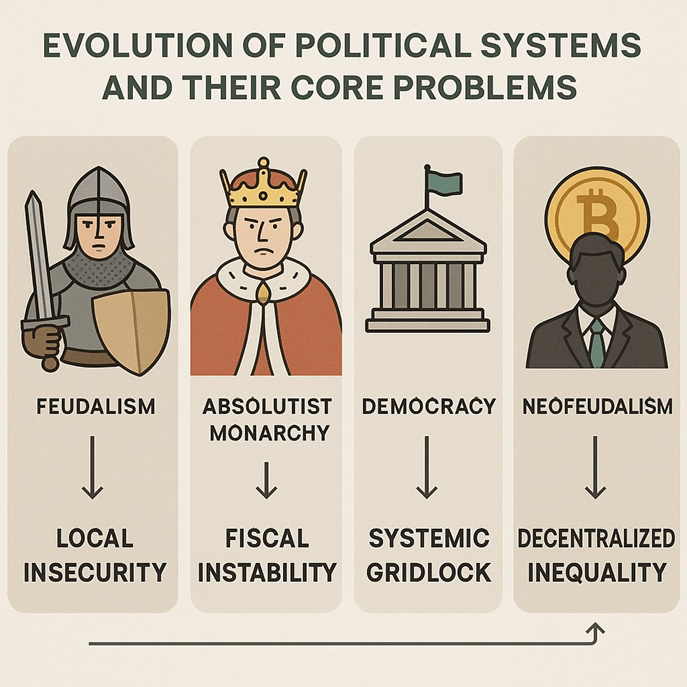
This observation patently applies to capitalism in its purest – and largely theoretical – manifestation. However, the emergence of what I have opted here to call Corporate Nobility ascribes to those at the top of the social pyramid in which we find ourselves something akin to feudalism’s concept of the divine right of kings. Alongside this, it is also noteworthy that the structuration of hierarchies that – to a large extent – are promoted as appearing naturally from the way of the world in which we find ourselves can be seen to defined by what – in Sartrean existentialism – are referred to as essences.
In principle, these are artificial impositions on us in terms of externally defined ways of being to which we are expected to subscribe and to embrace in practice. Meanwhile, though, existentialist thought expressly states that existence precedes essence, by which is meant that it is the actuality of how we live our lives in the moment, in terms of exercising our freedom and choice, which serves to constitute us as human beings. Hence, to return to Hägglund’s construct, if I accept my definition as a worker in the capitalist realm, I am denying my innate agency to live my life as I choose…and, in so doing, am reinforcing social structures which serve to reinforce and reproduce a system that is experienced by the vast majority of us as inherently iniquitous and overly constraining of us as people looking to live our finite lives meaningfully on this pale blue dot in the void.
The philosopher further develops his perspective by explicitly interrogating the relationship between our lives and the time that we have in which to live them. In light of his combination of existentialism and Marxism in respect to sensemaking in our lives, he offers a grotesque view wherein our very existence is ascribed a monetary value in a capitalist society:
‘[W]hat is recognised as our own is the time of our lives. I may not own any property, and all the property I own can be transferred to someone else. But what is irreducibly my own – what belongs to me for as long as I live – is the time of my life. When I sell my labor time to someone else for a wage, I am therefore necessarily selling my own life. My time cannot be separated from my life, and under capitalism my time is explicitly recognised as valuable.’ (pp238-39)
In terms of tying together how our existence feels constrained by the facticity of a world structured by capitalism and the emergence of what is being described here as Corporate Nobility – a feudalistic development occurring within capitalism – the following couplet seems pithily insightful:
Capitalism denies our Existentialist Freedom. And Managerialism protects Capitalism from Critique.
The social, cultural and economic facticity of the system in which we find ourselves thrown actively promotes the pretence of agency – but, in practice, inhibits the associated freedom and choice that are intrinsic to being a human being. This relates to how we opt to live our lives as individuals – and the important choice we might make as an individual to connect with others. Hence, we have the capacity to embrace both personal and collective change – but to exercise this freedom would have the potential to place considerable pressure on capitalism as a system.
The feudalised manifestation of contemporary capitalism effectively dismisses the idea that the system is meritocratic. Instead of supporting the traditional view that capitalism is founded on multiple opportunities for people to earn the opportunity to progress on the basis of their competence and willingness to take risks, the current discourse fixates on status as opposed to potential or actual achievement. It encourages the illusion that we are free to choose to create success for ourselves in a supportive circumstances…but opts to ignore the simple fact that these supposed choices are only able to be considered and explored within an extremely constraining set of boundaries.
The Dual Discourse of Corporate Nobility
Undergirding this world view are two closely interrelated discourses: one rationalises hierarchy, managerialism, and huge salaries at senior levels by maintaining that people in these roles are directly and exclusively responsible for the success of the corporate context in which they work. This is perhaps best articulated as Premiership Management, wherein the coaches of England’s most noteworthy football clubs are deemed to be the sole source of success – and conversely, they are exclusively responsible for the failure on the part of the club to progress and are penalised for this by dismissal.
In contrast, the counterweight discourse celebrates effort and position as opposed to actual outcome, which allows high profile leaders in organisations not achieving what is expected to be celebrated – and, as a result, rewarded by new roles and hefty pay offs. This also leads to musical chairs at the C-suite level, where the same faces appear in a range of senior positions again and again regardless of how effective and innovative they have been in their various roles.
These ideological perspectives serve to shroud the way in which the system in which we live actually works. The myth of recognition arising out of achievement has slipped back in favour of an artifice wherein seniority in terms of position arises out of a cultural framing. The idea of progressing to become a “manager” or “corporate leader” and maintaining that position as an essentialist view of success arises out of something akin to magical status as opposed to meaningful presence and engagement with those around you.
It is vital that we critically interrogate this feudalistic position – and use our existential nature to challenge it and the ideas that underpin it. This means that we need to embrace our freedom and the vital capacity to make active choices in respect to the living of our lives in order to position ourselves differently in relation to the way in which the world currently appears – and to connect with others, including those alongside side and those gifted senior status in our workplace settings, to challenge the way in which we find the world and envisage more honest and better ways of living therein.
 Radical OD