
A short but crucial step
At times when we face change as something that is visited upon us by others, as opposed to created or actively embraced by ourselves, looking after ourselves is vitally important.
My experience as a facilitator of Healthcare Leadership Model (HLM) 360 feedback exercises and reports leaves me feeling that there is value to using those responses as a way of developing an understanding and appreciation of where we are and where we might seek to head next.
At a deeper level, it has the potential to assist us to appreciate our own agency, which far too often can feel effaced by the corporate circumstances in which we find ourselves. This is a topic that I pick up in great detail in my new book to be published later in the year, which is entitled Being at Work: Using Existentialism to Make Sense of Your Organisational Life.
However, a short while back, I began to critically consider various elements of this process. First and foremost came a recognition that the feedback arose out of a social power dynamic, which required us to engage mindfully with what we were hearing. The feedback consists of opinions, not necessarily facts – so it does not provide meaningful insight until such time as we engage with it reflexively.
Secondly, arising out of this, it suddenly felt apparent that focusing exclusively on what others had said about us denied us the opportunity to expand our critical engagement with the overall workplace environment in which we find ourselves.
In light of this, I began to consider how it might be possible to expand the relationship in the 360 feedback arrangements to encompass the wider context in which that activity occurs. I began to consider how it might be possible to hear and reflectively explore the feedback that was being offered – but, at the same time, appreciate that organisational hierarchy and the individual perspectives on the world of the various respondents needed also to be taken into account.
Power is present in every nook and cranny of the workplace – and not just in the top-down pyramid that tends to define how we thing of ourselves at work. Hence, there is great virtue, to my mind, in bringing power to the fore and openly describing to ourselves how it affects us and impacts others. In this regard, I adhere to a Foucauldian notion of power, which recognises how it inhabits all human connections and is intimately related to the formalisation of knowledge, which so often announces normalcy…and, in so doing, inadvertently Others those who sit outside of that definition.
In light of this, I ended up undertaking some conceptual work as to how the 360 process could be rendered all the more panoramic and all-encompassing of the complex dynamics that exist in a workplace.
I share here a diagram that encapsulates for me the issues in this sort of exercise that need to be recognised, acknowledged and actively addressed…
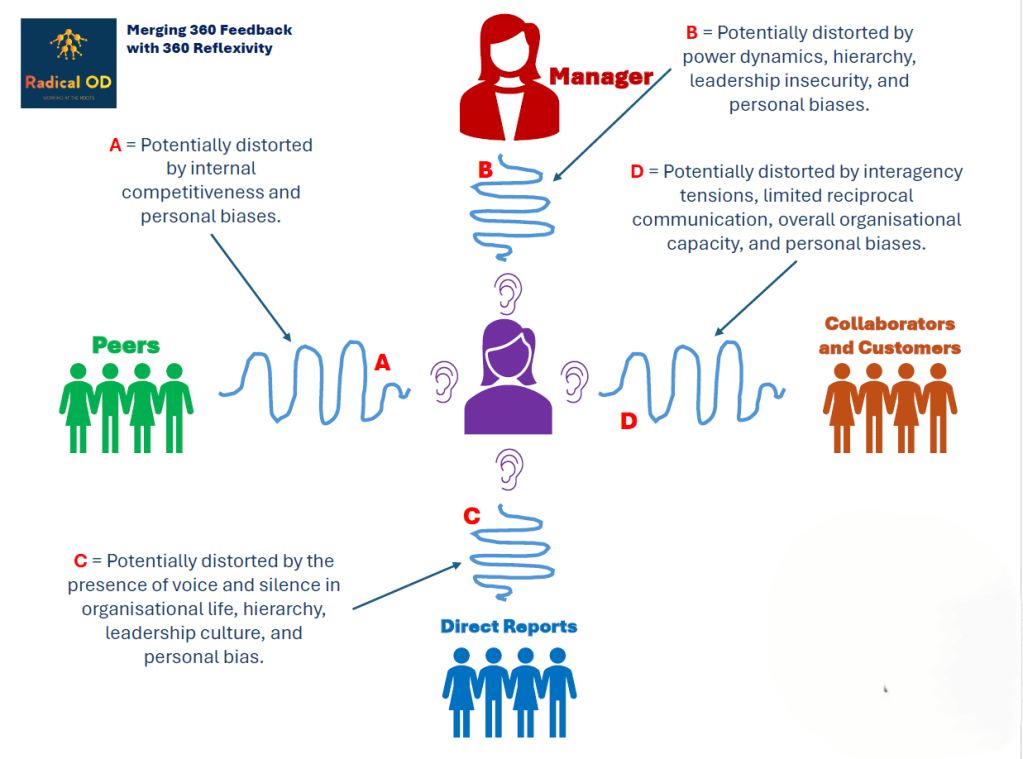
Additionally, here is a document that suggests how I now work to support people going through a 360 feedback process who wish to interrogate their feedback in a reflexive fashion – and to explore the wider context in which this exercise is taking place.
Despite having stepped away from the NHS two years ago, after nearly 40 years working in and around the corporation, I continue to offer my services as an HLM 360 Feedback Report facilitator. I see great value in the exercise, both for the person receiving the feedback and for me in support of them, given the rich conversations that regularly occur in these meetings.
Lastly, if you are intrigued as to how we might apply key concepts of existentialism to our working lives, which can be seen to occupy nearly 85,000 hours of the limited time that we are able to enjoy across our time on this wonderful pale blue dot adrift in the universe, here is a piece promoting a workshop that I am able to deliver…


When I was first introduced to 360 feedback after I joined the NHS, other than thinking of all the subjective bias errors it is liable to, I did think the responses my colleagues give to each other will say more about them than anything else and that to collate the feedback from such exercises and then theme them, would be a fun exercise and in part a snap shot of the modern workplace.
LikeLike