
Given where I have reached in respect to my experiences from a good many years of workplace activity and my role as a freelancer and writer these days, I have decided to offer my experience and services via a trusteeship or non-executive director type role. In light of this, I recently applied for two opportunities, one with the Professional Standards Authority and another with the national Citizens Advice Bureau.
A few weeks later, I received standardised rejection emails from these organisations, both of which declared that I was not suitable for shortlisting. In these anodyne statements, there were powerful reminders of how lacking in basic humanity essential HR practices can feel.
One rejection blandly and somewhat ungrammatically stated that “In order to secure our resources we are unable to give feedback to external applicants who have not met our shortlisting criteria or invited to interview”. The other somewhat selfishly observed that “We had a large volume of applicants and so are unable to provide feedback on individual applicants.”
Such dour and unthinkingly corporate observations suggest a failure to recognise that, whilst HR’s customers certainly exist within the organisation that the function chooses to serve, applicants are also part of the function’s clientele.
From Personnel to HR – The Triumph of Managerialism
Unfortunately, we have moved from a point where HR was a sensibly independent occupation that thoughtfully and professionally sought to maintain an acceptable balance between the occasionally competing agenda of the bosses and those of the staff to one where HR is exclusively committed to managerialism.
Partly, this transition has been facilitated by the corporate embrace of the leader-follower fictional fantasy, an ideological construct that has developed latterly in order to efface the reality of different perspectives, tension, and potential conflict in the workplace.
This is not to allege that leadership and followership do not need to exist wherever human beings come together, particularly where they are in pursuit of a collective aim. However, a contrast needs to be made between the leader-follower binary as an imposition that serves to silence dissent and resistance under its crude illusion of a fixed complicit division between lead and follow and the more grounded understanding that leadership is a space that opens up as human groups find their way together in terms of exploring and realising their ambitions and where, as a result, a range of different people have the potential to step in and step out, in light of the needs of the moment and the talents of the respective individuals.
Feedback Denied
To return to the issue as to who are their customers, who do they serve, and what view is taken across the occupation as to its contribution in corporate settings, although we hear a lot of talk within the overall managerialist discourse about how HR has a crucial role in respect to what is referred to as employer brand, the sort of experience that I have endured recently of pretty much being told between the lines that, “You may have spent a couple of hours carefully crafting an application for our company to consider but we simply can’t be arsed to give you any meaningful insight into your suitability for the role that we are seeking to fill” lacks gratitude and a commitment to genuinely engaging with the wider labour market.
Despite having stated that they had no intention to offer any insight into why I was deemed unsuitable in respect to my application, one of the missives made the following anodyne remark: “Please continue to identify roles advertised on our recruitment site that may be suitable for you.”
Yet this ignores the fact that I actively applied for a role for which I clearly felt that I was well suited, and I am now being told that this was not the case…but no detail is being provided as to why my profile was not seen to be suitable for the appointment.
Some of this, of course, will be very much down to the institutional defensiveness that one finds in so much corporate HR practice. Again, this indicates a commitment on the part of HR to sustain the hierarchy and not to meaningfully challenge the rigid structures that persist in organisational life. That adherence to managerialism means two things: firstly, the focus of the practice in this field of corporate activity is on the control of human resources as opposed to the engagement with a range of human beings who have chosen to use their talents and capacity to meet the needs of the company that they have chosen to join.
Secondly, in light of this, it looks to prevent those involved in HR from recognising that they too are viewed as a resource in the service of managerialism – and that, in having embraced the role defined for them in a corporate setting, they have assumed an inflexible bureaucratic approach and hence inadvertently lost a meaningful commitment to working humanly.
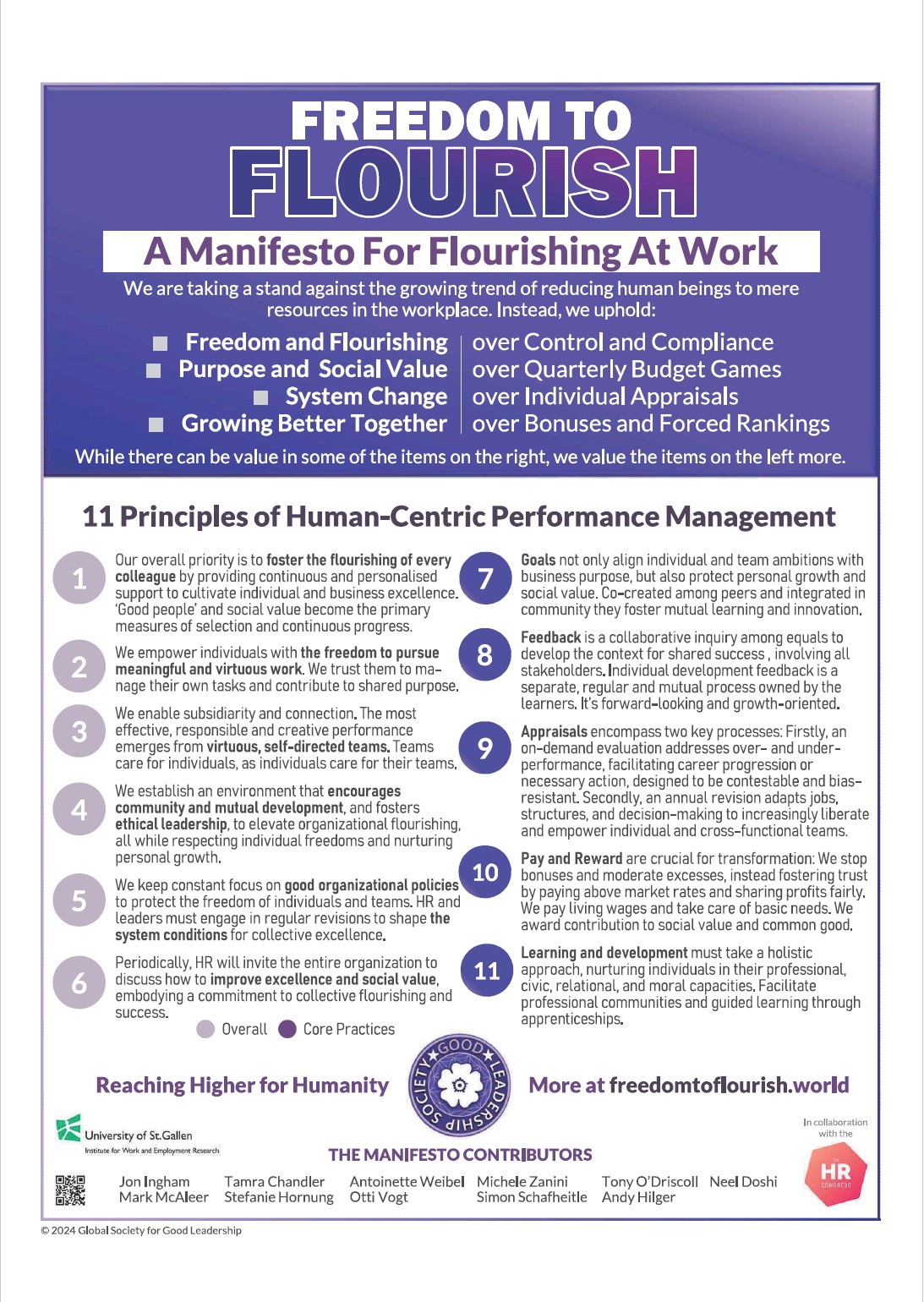
All of which served to remind me once again of the superb campaign that exists to ensure that HR works in order to actively support people to flourish at work. The thoughtful manifesto of that initiative appears below and is very much worth dwelling upon – reflexively if you find yourself working in an HR function in corporate life.
My experience leads me to think that HR’s responsibility in that regard – with a focus on putting the human being at the centre of theory and practice in this realm – extends beyond the boundaries of the firms in which it resides and should be looking to actively support those human beings who have expressed an interest in joining a company but whose application has not been successful.
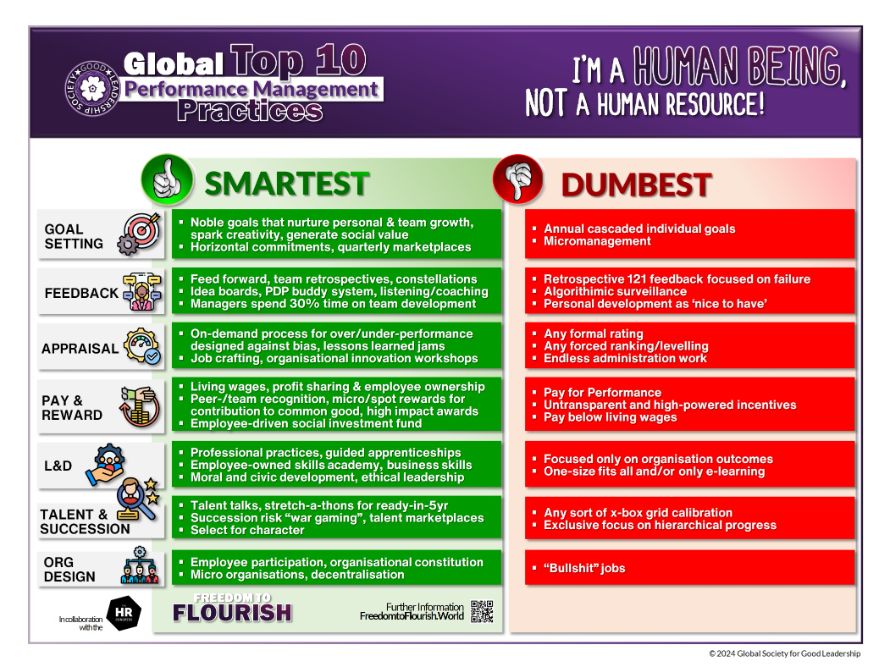
It’s time to revolutionise HR instead of simply allowing it to prop up an absurd system. Those working in the function need to find their voices to challenge extant ways of undertaking this work…and they need to speak up and speak out about how we can genuinely begin to deeply humanise organisational life instead of uncritically sustaining it and just occasionally being involved in some reformist tweaking of those oppressive circumstances. Let’s put an emphasis on the far too often ignored or utterly neglected human element of Human Resources.

