In my book entitled “Radical Organisation Development” which appeared in 2019, I critically interrogate the way in which I had professionally approached organisation development (OD) across nigh on 36 years of my overall career.
I took the view that a lot of my activity had served to prop up corporate situations that would actually have benefitted from active contestation. Crucially, I noted how my OD practice to date had not acknowledged and discussed the presence of power in the workplace.
Personally, I became mindful of the way in which so much OD in company settings was delivered as if it were light entertainment. Far too often, so-called facilitators are engaging with the groups with whom they are working as if they were stand-up comedy audiences!
Additionally, the events that OD facilitators put together very often have the feel of a game show, where – for example – participants are placed in teams in which they are challenged with building a tall tower using sticks of spaghetti and marshmallows or they are provided with a children’s toy that is commercially rebranded as being something “serious”.
I took my analysis beyond just critically engaging with how I had chosen to do my work to date and so also crafted for myself a set of intentions as to how I would do that work henceforth. This alternative approach was built upon the following:
- An active acknowledgement of the presence of different practices of power in corporate settings.
- Finding one’s voice to speak truth to power – and encouraging that amongst those with whom one is working.
- A focus on organising as opposed to organisation.
- Embracing reflexivity in terms of authentic sense-making.
- An existential as opposed to essentialist orientation.
- A commitment to deconstruct the structured layers of contemporary organisations.
- Disruption of the existing dominant discourse to offer space for alternative – and often subaltern – voices to be properly heard.
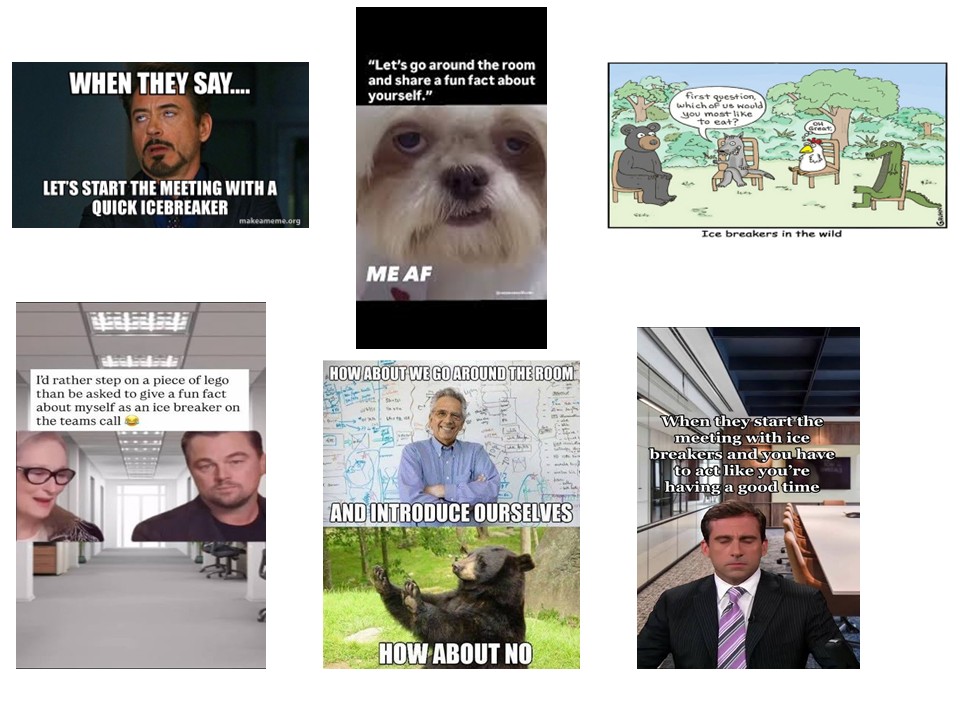
What does this mean in practice? Well, let me use the idea of the “icebreaker” – which is often applied as the introductory aspect of the “OD game show”- in order to explain this. Many people find this type of exercise intrusive and oppressive, and yet it continues to be used. A quick google search throws up a remarkable number of negative memes in this respect, just a few of which are captured here:
If you are serious about opening up meaningful dialogue both across and also up and down the organisation in which you are working, then it is a question of actively contesting the idea of the necessity of traditional icebreaker exercises in a context of connected humanity.
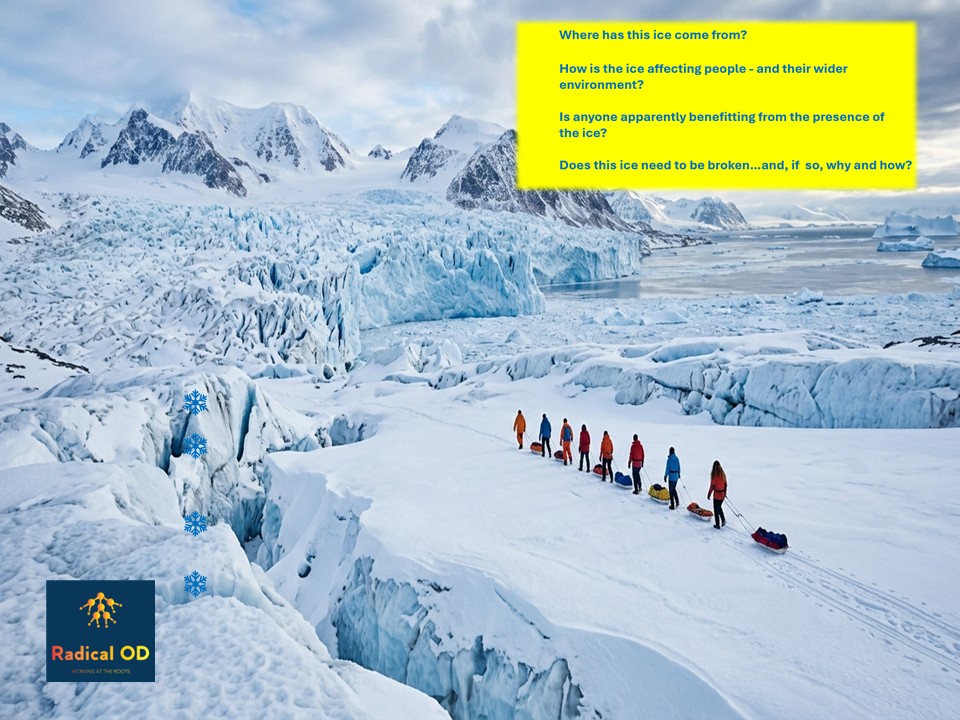
Instead of forcing people to play a game to supposedly “break the ice”, there is an opportunity for a collective inquiry into the nature of ice and how people experience it in the moment. Instead of compelling people to engage in a kindergarten activity, we should offer space and time for a discussion around questions like the ones listed in the diagram below:
Offering people the opportunity to have this type of conversation creates a connectivity and potential for candour that is of massive value when it comes to human beings in collaboration. And, specifically, the hosting of a situation where people’s actual experiences can be reflected upon and discussed is the active exploration of things that actually matter – and the meaningful exploration of the circumstances in which those people find themselves.